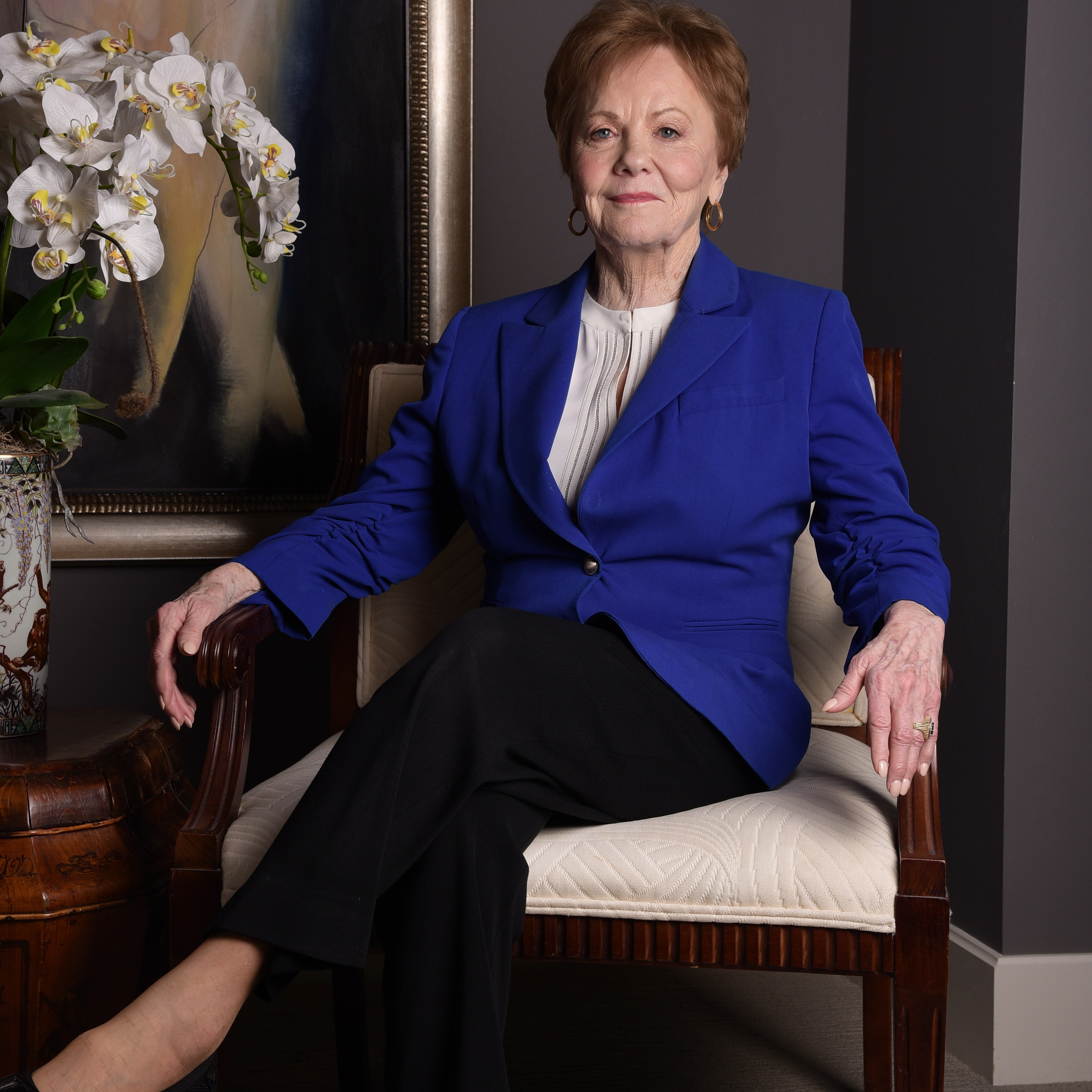
Together, we commemorate the life of
Kay Granger
By In Memory of the Honorable Kay Granger
Please donate in honor of the Honorable Kay Granger
Kay Mullendore Granger, the first Republican woman to serve as Chairwoman of the House Appropriations Committee in Congress, died peacefully surrounded by her family on August 2, 2026 following an aggressive late battle with Alzheimer’s.
Her life was the stuff of legend. Her remarkable journey from a small East Texas town to one of the most powerful positions in Congress was a uniquely American story of a woman who came from so little and yet went so far and achieved so much.
Born January 18, 1943, in Greenville, Texas, Kay learned early on that there were no short cuts on the road to success. At an early age, she learned the value of hard work and persistence. She saw this modeled in the life of her mother, Alliene Mullendore. When the family moved to Fort Worth, Kay’s mother began her long career in public education starting at age 17. She started as a teacher and earned her way through the ranks. She became the first female principal and woman to serve on the school board in the Birdville school district. Kay’s mom made a difference, and this made an impression on Kay who always called her mother the greatest influence in her life. Her mother always tried to make the world a better place, Kay often said. And she wanted to do the same.
After graduating from Eastern Hills High School in Fort Worth, Granger attended Texas Wesleyan University, where she earned her bachelor's degree in 1965. Then, just as her mother had done, she became a teacher. She loved teaching. She often said, “most people spend lives building careers; teachers spend their careers building lives.” Like her mother before her, she enjoyed mentoring young people and giving them the tools to find their own success.
It was during this time that she got married and started a family: first a son arrived, J.D, then twins, Brandon and Chelsea. When Kay later found herself as a single mom, she changed careers to provide for her family. Her mother. Alliene, who moved in after a stroke, helped with the kids. She began an insurance career with Northwestern Mutual where she quickly became the top producer. Kay then started her own insurance agency, Kay Granger Insurance. And she began to get involved in her neighborhood.
It was at this time that Kay was “introduced” to public service. Kay never sought nor desired to be in the spotlight or hold office. However, a proposed zoning case in her neighborhood threatened what she felt was her only asset that she had for her family, her home. On behalf of the neighborhood, she appeared and fought the proposed zoning. She prevailed and impressed. In 1981, she was asked to represent her East Side community as a member of the Fort Worth Zoning Commission. She agreed because she thought it would be the best way to protect her neighborhood. And thus began her long career in public service.
She made such an impression during her time on the Zoning Commission that community leaders asked her to run for City Council in 1989. She did, and she won. Then, in 1991, with the retirement of her friend Mayor Bob Bolen, Kay ran for, and was elected, Mayor—becoming the first female Mayor in Fort Worth history.
It was a big moment, and she faced even bigger challenges. Fort Worth was suffering from one of the worst crime rates in the country. And the Department of Defense announced a series of military base closures that could have meant the end of Carswell Air Force Base.
In the face of these obstacles, Kay saw opportunity. To fight crime, she championed a “crime district” initiative that put more cops on the street and brought down crime so fast that Fort Worth became the safest big city in the country by the time she left office four years later. She also aggressively pursued tax incentives to lure new companies to Fort Worth. And she was instrumental in making Ross Perot’s dream of AllianceTexas a reality.
But nothing set the stage for her next move in public service more than her work to save Fort Worth’s military base. She assembled a team of business and community leaders, talked to officials at the Pentagon, worked hand in hand with Congressman Pete Geren, and helped propose a compromise. Rather than close Carswell, why not transform it? As the military became increasingly interconnected in the 1990s, Kay championed creating a new model where all the branches would work together at one location. The result was the Naval Air Station—Joint Reserve Base in Fort Worth which today is more active, with more service members, than it had when it was Carswell Air Force. As was so often the case, Kay didn’t just help save it, she made it better.
This exposure to Washington helped show her that her problem-solving leadership might be needed there as well. When another friend, Congressman Geren, announced he was retiring, Kay was again recruited to run for office. And she again made history becoming the first woman to represent Congressional District 12 in Washington - and the first female Republican to represent Texas in Congress.
She took office on January 3, 1997, and would serve her constituents for the next 28 years. During this time, she continued to fight for what was best for the people she represented. To support local industry as well as national defense, she was a fierce advocate of defense spending and especially Fort Worth-related projects like the F-35 at Lockheed Martin and the Osprey at Bell. To create economic growth for all Americans, she proudly worked on, and voted for, the tax cuts signed by President Clinton in 1997, President Bush in 2001, and President Trump in 2018. Indeed, one of her first pieces of legislation to be signed into law was a bill to help families save money for college, the tax deferred 529 college savings plan. Speaker Newt Gingrich personally asked that her bill be included in the Taxpayer Relief Act of 1997, and it was.
By the end of her first term in Congress, she had already made such an impression that the leadership of the House of Representatives moved her to the prestigious and powerful Appropriations Committee. Here she would serve for the next 26 years. And what a remarkable run it was. During these years, Kay served on eight of the committee's twelve subcommittees and became a leading Congressional expert on national defense and foreign policy.
Eventually, Kay would become the first Republican woman to sit on the Defense Appropriations Subcommittee—and later served as its Chairwoman. As Chairwoman, she wielded significant influence over the single largest portion of the federal budget. And her priorities were consistent: bolstering America's military capabilities, ensuring adequate resources for service members and their families, and resisting what she saw as harmful, arbitrary budget cuts to national defense.
She also possessed a deep knowledge of the broader world. She would eventually also serve as Chairwoman of the State and Foreign Operations Subcommittee. In this role, she traveled all over the world meeting with allies and working on mutual security interests. And during the War on Terrorism, she took a particular interest in training Iraqi and Afghani women for public service.
In her oversight role as Chairwoman of the State and Foreign Operations Subcommittee, she insisted on transparency and accountability in the State Department and the diplomatic community. She was relentless in pressing the State Department for answers after the attack on the U.S. diplomatic compound in Benghazi, Libya, in 2012.
In 2018 and 2020, her colleagues elected her as Ranking Member of the Appropriations Committee. As the leader of the Republican Members on Appropriations, she continued to champion investment in national defense and transportation and still found ways to work closely with the Democratic Chairwoman of Appropriations, Congresswoman Nita Lowey.
Then, in 2022, Kay achieved another first. Kay reached the top of the “greasy poll.” She was selected to serve as Chairwoman of the House Appropriations Committee in the 118th Congress, making her arguably the most powerful person in the House of Representatives. She was the first Republican woman ever selected to chair the U.S. Appropriations Committee. She continued to serve in this role until April of 2024 when she stepped down to become Chairwoman Emeritus of the Committee. In late 2023, she announced she would retire at the end of the 118th Congress.
Throughout her time in Congress, she was always a team player, but never failed to do what she thought was right no matter the consequence. When taking part of an oversight hearing on F.E.M.A.’s handling of the Hurricane Katrina aftermath, she made national headlines when she challenged the Bush Administration and confronted F.E.M.A. Director Michael Brown, telling him pointedly: “"I don't know how you can sleep at night. You lost the battle.”
And when President Donald Trump suggested cutting back on the F-35, she let him know, as only she could, that she wasn’t going to let that happen.
Along the way, she also had a knack for identifying and mentoring the next generation of leaders. In 1997, she hired as her first chief of staff a relatively obscure Capitol Hill staffer named Ken Mehlman who went onto become Chairman of the Republican National Committee. And in 2010, when she needed to hire a campaign manager for her re-election campaign, she chose a young legislative staffer named Mattie Parker who herself went on to become Mayor of Fort Worth.
Her staffers love to tell stories about working for her. She was always tough but never unfair. And she had no patience for pretentious people. Once, while serving as Chairwoman of the Appropriations Committee, she had trouble getting a phone call scheduled with the director of a federal program. When the director finally agreed the call, Kay began it by saying: “I am the Chairwoman of the House Appropriations Committee. Who do you think you are ignoring me for two weeks?”
Her staff also got to see a softer side. During an all-nighter working on the floor of the House on an Appropriations bill, she returned to her office in the Cannon Office Building unexpectedly. So unexpected that one of her exhausted staffers was enjoying a beer.
“What are you doing?” she ominously asked.
“Drinking a beer,” the nervous staffer responded
“Do you have anymore?” she asked. Then she popped a top, sat down and drank a beer with him.
Perhaps most of all, during her entire 28 years in Congress Kay never failed to dream big dreams. She never took no for an answer. Coming from such humble beginnings, she knew anything was possible. She was living proof. As a result, she always thought big. When she examined the need to shore up the levees along the Trinity River, she again saw an opportunity—Fort Worth could transform a large heavily blighted area that was limiting the growth or her community’s downtown into a place that would both be protected from flooding and create a vibrant new center city destination. And in one of her greatest achievements in Congress, she worked with her friend Congressman Marc Veasey and the Biden Administration to secure $403 million in funding for the project in 2022.
She said on the night she was first elected to Congress in 1996, that her goal would be to “attack problems, not people.” And throughout her life and career, that wasn’t just what she did, it was who she was. She wanted to solve problems and bring people together.
Still, in a long life of exceptional service and accomplishment, Kay always said her greatest achievement was her family. She is survived by her son J.D. Granger and his wife, Shanna; her son Brandon, and his wife, Erin; her daughter Chelsea Hughes; and grandchildren Jack Granger, Kirby Kate Granger, Logan Granger, Gage and Aiden Hughes, niece Robin O’Day Dettmer, and nephews Steve and Tim O’Day.
Kay always said she wanted to be like her mother and leave the world a better place. She did exactly that…in so many ways, for so many years.
Her life will be missed, but her legacy will never be forgotten.
Our mother had more to offer, Alzheimer's had other plans for her. And she isn't the only one. Every day we have friends that approach us to commiserate. They are or have experienced the exact same loss. The loss of a loved one to Alzheimer's.
After losing our mother to Alzheimer's, we wanted to honor her memory in a way that would make a difference. Every dollar that is donated to Kay's tribute page will go straight to research.
We would be so grateful if you would make a memorial gift in her name. It would mean a lot to us and those facing this relentless disease.
Thank you in advance for your kindness and generosity.